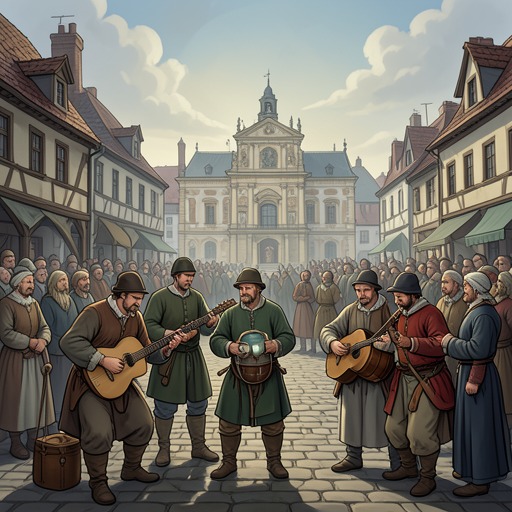
The Schism of the Music Religion and Rule by Musical Elites
Last and First MenThe Schism of the Music Religion and Rule by Musical Elites marks the breakdown of a millennium-old order that had turned a compelling belief in music into both a social doctrine and a basis for political authority. The schism began as a dispute over where religious truth resided: in an individual’s intense experience of music, or in the formal structures of music itself. Among the peoples who rebelled against the established church, that disagreement also became a program of selective breeding. Its success produced exceptionally music-sensitive people who, for a brief period, ruled as a tyrannical caste; the order they embodied ended in chaos and civilizational collapse.
The religious order and its growing contradiction
The Holy Empire of Music had given the species order and purpose for a thousand years. Its law rested on the sayings of the prophet, interpreted by successive rulers, and gradually supplanted local codes through its claim to divine authority. Beneath the official language of melody and social harmony, the system treated people as organisms with needs, rights, and obligations, while representing each person as a melody to be completed within society’s larger theme. This combination of practical social organization and religious metaphor had made the empire durable, but its symbolic account of life could also obscure the difference between spiritual experience and institutional rules.
Toward the close of the millennium, devout critics argued that the church had lost the religion’s original purpose. The prophet had preached salvation through individual musical experience and an intensely emotional communion with Divine Music. In the critics’ account, ecclesiastical authority had displaced that inward experience with an arid concern for objective musical forms and the rules of an obscure technique. What had begun as a way to express divine law through social life, they charged, had been turned around: churchmen and statesmen had interpreted the supposed laws of music to suit social convenience. The dispute therefore challenged not only religious doctrine but also the institution’s claim to embody the faith.
Rival accounts of musical devotion
The rebellion did not produce a single shared definition of the religion’s true spirit. While the rebels emphasized subjective experience and the individual’s emotional communion with music, a counter-revival ridiculed what it regarded as the rebels’ self-absorption and concern with personal salvation. Its adherents urged people to value the divine, exquisitely ordered forms of music in themselves, rather than making music serve individual feeling. The contest thus set two competing priorities against one another: music as lived, inward experience and music as an objective order deserving attention for its own sake.
Neither position simply separated music from society. The established religion had made musical language a way to describe social obligations, while the schism concerned whether the faith’s center was personal feeling, formal order, or the social system built in music’s name. That tension gave the rebellion its reach: it was a challenge to ecclesiastical interpretation and to the authority of those who claimed to administer the musical order. The account does not describe the rival camps as reaching a reconciliation. Instead, the division becomes part of a wider transformation among the rebel peoples, where religious commitment takes a biological form.
Selective breeding and the new musical type
Among the rebel peoples, the race’s previously subordinate biological interests gained prominence. Some devout women began to let the desire for children of exceptional musical brilliance and sensitivity influence their choice of mates. Biological science remained rudimentary, but the general principle of selective breeding was understood. Within a century, breeding for musical ability—described as breeding for soul—had grown from a private idiosyncrasy into a racial obsession.
The policy altered the population. A new type became common and flourished amid the devotion and approval of ordinary people. Its members were so sensitive to music that the song of a skylark could cause them serious distress through its banality. Music they approved of reliably sent them into a trance; music they disliked could provoke them to attack and kill its performers. The account links this heightened sensitivity to the social consequences that followed, without presenting it as an uncomplicated fulfilment of the rebels’ religious ideals. A project intended to cultivate musical brilliance had produced people whose responses could make musical judgment a source of danger and power.
Elite rule and civilizational collapse
Over time, the wider population submitted to the whims of these beings, and for a brief period they became the tyrannical ruling caste of a musical theocracy. The account does not pause over the stages by which their authority was established; it emphasizes the reversal by which a faith-centered effort to recover the religion’s spirit helped make rule by exceptional musical sensitivity possible. The resulting dominance reduced society to chaos. An age of confusion and killing eventually brought humanity back to its senses, but not to a renewed common purpose.
The collapse was followed by profound disillusionment. The effort to redirect the race’s collective ambitions lacked determination, and civilization fell apart. It was not rebuilt until the race had lain fallow for several thousand years. The episode is described as perhaps the most pathetic of racial delusions, yet its ending retains a qualified dignity: the delusion had been born from a genuine and potent aesthetic experience, and kept a certain crazy nobility to the end. The schism’s significance lies in that double outcome. A real encounter with music’s power had been made into doctrine, then breeding policy, and finally political domination; the resulting order could neither preserve the experience that inspired it nor survive the power it had helped create.